


July 27th meeting raises questions about spending limits, nonprofit funding, transportation priorities and unresolved property and utility issues
Video of June 27th meeting available here.
Sequim City Council’s July 27, 2026 meeting brought financial limits and accountability questions to the forefront, beginning with a work session on municipal funding and continuing through discussions of transportation projects, legal representation, the city’s finances, a disputed property issue and unresolved utility billing questions.
The council met for a 5 p.m. work session before the regular meeting.
Councilor Janisse was absent from the work session only. Matt Huish was absent from both meetings.
Municipal funding requests exceed the city’s target
The work session focused on applications for municipal funding.
Christy, the city’s new executive assistant, gave the presentation. The material presented to council included the current funding requests as well as a history of previous applications and awards.
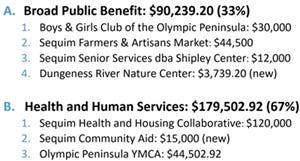
The above chart shows who applied for municipal funding this year and how much each organization requested.
The city’s municipal funding cap is 1.5% of the general fund, or approximately $210,000.
The current requests exceed that target by $59,742.12.
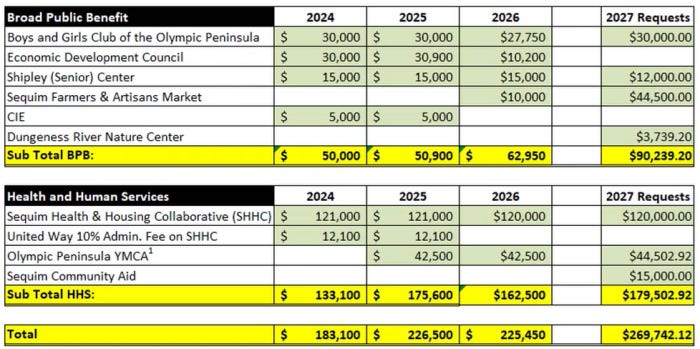
The above chart shows previous applications and how much each organization received — or did not receive — in prior years.
Council members will score the applications and turn in their scores by August 3. A final decision is scheduled for today, Monday, August 10.
Councilor Dan Butler asked whether the city was projecting the budget lower this year.
Sue Hagener said $14 million is the best estimate and reported that the city is approximately $250,000 in the red.
Hagener also reminded council that it exceeded the 1.5% policy last year.
Butler then asked about the city’s support for the farmers market. The city provides the venue, power and direct funding, with this year’s funding level a little over $10,000.
The market is focusing on food accessibility.
Butler asked whether, if the city has to make cuts, some organizations could receive additional in-kind assistance instead of direct funding.
Councilor Rutter thanked Christy and Sue for their time and thanked Butler for asking the questions, saying it was an interesting process with much to contemplate.
No ceremonial business
The regular meeting had no ceremonial items.
Val Shaw again raises tree-damage concerns
During public comment, Val Shaw again spoke about damage to trees on her property associated with Hammond expansion work.
Shaw said she was asked to temporarily move her fence to accommodate the work and that afterward, no one visited or spoke to her after she made the city aware of the issues.
She brought visual aids.
One was the positive: the torch she carried in the Olympics.
The other illustrated what she described as the extreme condition of the trees — a large piece of wood she called a “widow maker,” demonstrating what she said was falling from the tree.
Shaw also brought a copy of the permit she said her mother was coerced into signing.
According to Shaw, those involved promised to leave the property as good as it was before the work. She said that did not happen.
She said she attempted to get the contract fulfilled but was told to “go eat heffer dust” — the wording is uncertain in these notes — a phrase she said her father used.
Shaw said she hired a forensic arborist who determined that the trees were compromised.
She said a representative responded that the arborist did not know what they were doing. Shaw also pointed out that the representative was not present when the work was performed.
Transportation Improvement Program looks years ahead
Nick Dosti presented the city’s Transportation Improvement Program, or TIP.
The presentation covered funding, costs and timelines for current and future transportation projects.
Dosti said that last year approximately 80% of transportation funding came from grants and 20% from the city.
Rather than wait on the Legislature, the city decided to apply for design funding for 101/Simdars.
Signals at 3rd and 5th are on the current list, while 7th is included in phase II.
Butler raised the danger to pedestrians and bicyclists on west Sequim Bay, an issue of particular interest in his neighborhood.
The project shown on the chart has been extended beyond 2032.
Dosti said projects can be moved forward when grant funding becomes available.
A public hearing on the TIP will be held at the next council meeting.
City changes rules for legal representation
The council considered a municipal-code amendment concerning representation for city officers and employees.
Attorney Nelson-Gross presented the item.
She explained that existing language is based on a law that is now outdated and concerns situations in which local governments may be required to pay for legal defense when employees are sued in their personal capacity.
Such situations do not occur frequently anymore, she said, and the city is therefore amending the code. The city is also making changes intended to provide better guidance.
The council retains final authority over whether legal defense should be provided.
Councilor Hartman questioned the wording of one section. Nelson-Gross said she would make the correction.
The ordinance is expected to appear on the consent agenda at the next meeting.
Financial report reveals additional pressure
Sue Hagener presented the financial report for the first six months of the year.
Among the items discussed was the criminal justice contract. The contract amendment was signed well after budget adoption and could add approximately $230,000 to the budget.
Hagener also addressed municipal funding.
Last year, the council went outside its policy and approved use of the rainy day fund for the YMCA’s municipal request.
Hagener said she may have to prepare a budget amendment to accommodate the YMCA’s contract.
Committee reports
Councilor Rutter reported that the Sequim Arts Committee meeting was canceled because of a lack of quorum.
Mayor Anderson reported that five students have been selected for the Sister City exchange program.
The students are scheduled to travel to Japan July 4–10, 2027.
HOA water-billing questions remain unresolved
During open discussion, Butler asked for an update on the HOA water utility process.
The issue dates back to earlier meetings when members of the public said they had been told they might have to repay as much as 10 years of past charges.
Gross-Nelson said the city is engaging a third-party consultant to examine utility billing and make sure the numbers and individual situations are accurate.
No decision has been made regarding repayments.
Only one August meeting
The council will hold only one meeting in August, on August 10.
That meeting is scheduled to include the final municipal-funding decision.
The article is not an official document of record; it was generated with AI assistance based on notes from a local citizen who watched the recorded meeting; the article was thoroughly proofread for accuracy prior to publication.
Today’s City Council Work & Regular Session
Date: Monday, August 10, 2026
Time: 5:00 PM & 6:00 PM
The Sequim City Council will hold a Work Session at 5:00 p.m. The Work Session is open to the public, however no public comment will be taken.
The Sequim City Council will hold its Regular Session at 6:00 p.m.
Address: Sequim Civic Center, Council Chambers, 152 West Cedar Street, Sequim, WA 98382
The Sequim City Council meets in person and virtually. The public may attend by coming to the Council Chambers, joining the Teams meeting, or participating via phone.
To view the meeting via Teams: Click here to join the meeting now (Meeting ID: 223 945 058 990 076, Passcode: ED36oG7w)
To hear the meeting by phone: Dial (253) 363-9585 and enter phone conference ID 738 862 249#.
Written comments may be delivered to the Civic Center or emailed to clerk@sequimwa.gov to be entered into the meeting record. Council will also take verbal comments during the meeting.
View the agenda here.
View the interactive agenda packet here.
Click on Splitscreen to view the agenda and agenda materials side-by-side
Editor’s Opinion: When Does Community Support Become Dependency?
When it comes to the organizations seeking municipal funding at the July 27th meeting, their requests raise a question that deserves more attention than simply deciding who gets a check this year.
When an organization has multiple ways to raise money — individual donations, recurring gifts, memberships, sponsorships, grants and fundraising events — yet still regularly needs taxpayer funding to meet its budget, is the organization financially sustainable on its own?
That does not mean the organization is poorly managed, nor does it mean its programs aren’t valuable. Nonprofits can provide important services while still facing legitimate financial challenges.
But recurring government funding can mask a deeper problem if an organization’s expenses consistently exceed the revenue it can generate through its own supporters and operations.
At some point, the question should shift from “How much should taxpayers contribute?” to “What does this organization need to change to become financially sustainable?”
That could mean examining programs and determining which are essential and which could be reduced. It could mean finding efficiencies in operations, renegotiating expenses, reconsidering staffing levels or compensation, increasing fees where appropriate, or finding new sources of private revenue.
None of those choices is easy. Cutting programs can hurt people. Reducing employee compensation or benefits can make it harder to retain good employees. Raising fees can put services out of reach for some people.
But continually asking taxpayers to fill the gap has consequences too.
Government funding can become an expected part of an organization’s annual budget rather than temporary assistance. And once that happens, the organization may have less incentive — or less urgency — to confront the underlying difference between what its mission costs and what its community is voluntarily willing to support.
The long-term goal should not be to determine how much taxpayer money these organizations can receive. It should be to determine whether their current business models are sustainable.
If municipal funding is necessary to provide a service the city has determined is genuinely a public responsibility, then the city should say so and fund it transparently.
If it isn’t a municipal responsibility, then recurring taxpayer support should not become the substitute for making difficult financial decisions.
Helping a nonprofit through a difficult year is one thing. Building taxpayer funding into its permanent business model is another.
The council should keep that distinction in mind when it makes its municipal-funding decisions.
City of Sequim Notifications
Job Opportunity for Full-Time Maintenance Worker: Learn more about the position and apply here.
Bid Posting for 2026 RFP for AC Pipe Condition Assessment: The bid is currently open with a closing date of August 21, 2026. Learn more about the Request for Qualifications/Proposals here.
Council Salary Commission Meeting: Tuesday, August 11, 2026
The Council Salary Commission will hold its first meeting at 2:30 p.m.
The Council Salary Commission meets in person and virtually. The public
may attend by coming to the Council Chambers, joining the Teams meeting, or participating via phone.
To view the meeting via Teams: Click here to join the meeting now (Meeting ID: 247 681 910 170 029, Passcode: fH7iQ6bd)
To hear the meeting by phone: Dial (253) 363-9585 and enter phone conference ID 120 456 705#.
Written comments may be delivered to the Civic Center or emailed to clerk@sequimwa.gov to be entered into the meeting record. Council will also take verbal comments during the meeting.
View the agenda here.
View the interactive agenda packet here.
Click on Splitscreen to view the agenda and agenda materials side-by-side
Watching is only the first step. If you have questions about city projects, policies, or decisions, reach out directly to the elected officials and city staff responsible for them. The City of Sequim directory is available here.
Citizens Keeping an Eye on Sequim
CJ, you are absolutely right about nonprofit organizations becoming dependent on the government teat! Why does the taxpayer have to support the YMCA, for example? Or the Dungeness River Nature Center, which is owned and controlled by JKT? These, among others, are not "essential services, are they?
Stop giving money away to favored programs. We can't afford it. Basic services like police need to be funded. Forget the fancy library and stupid pet projects!